


[Part1 introduced the conundrum of whether a founder can siphon money out of business to help their family. Check AfricanAccelerationism.com]
Being Christian is good for business
“Me and mine” is the natural state of humans. Pre-historic clans would consider it a moral right to kill a foreigner they see and take their bearskins and take their wife. Like, of course, how else would you treat someone from another clan?
If you don’t take their bear skins and women they’ll take yours!
It’s only with cities and countries that large-scale cooperation becomes required. This large-scale cooperation became possible with modern religions.
For business to work, to trade with other people at a large-scale, they need to believe you are not going to steal their women and bear skins, regardless of what tribe they come from.
Here’s how modern religions changed that. (Christianity, but also Islam, Hinduism, Buddhism, Confucianism, etc)
Jesus encouraged:
Monogamy: “the overseer is to be above reproach, faithful to his wife.” No point in stealing a wife if you already have one and there are enough to go around.
Forgiveness: The Code of Hammurabi had eye-for-an-eye justice. But Jesus said to “Turn the other cheek.” This prevents feuds that escalate.
Quality workmanship: “Whatever you do, work at it with all your heart, as working for the Lord, not for human masters.” This creates an extra incentive for quality: please the Lord, in addition to pleasing the customer.
Individual Conscience: “Each of us will give an account of himself to God.” Personal accountability enables internal controls, audits, and responsibility assignment. Without it, blame dissolves into group blame. You can no longer say “x tribe always steals.” You say “Ben stole” — individual guilt. Not group guilt.
Truth: “The truth shall set you free.” Enables accounting, auditing, science, and contracts. If truth bends to power, numbers become fiction and markets fail.
Jesus invented a more scalable way to relate to each other. Two thousand years later, it is still relevant.1
Take the Parable of the Good Samaritan (Luke 10:29–37):
A man is attacked by robbers, left for dead. A priest (priest!!) and a Levite (Hebrew of the tribe of Levi) walk past the man without helping. But a despised Samaritan stops to help, bandaging his wounds, taking him to an inn, and paying for his care. Jesus taught that “neighbor” is anyone in need, not just one’s own group.
Jesus’ teaching is clear: “Do to others as you’d have them do to you”—the Golden Rule.
This is called Moral Universalism. Christians are instructed to treat people as having equal worth even if they are not from our tribe or ethnic group. This was a huge innovation. Moral Universalism is foundational to a scalable economy in christian countries.
“But! But!” You say. “Kenya/Africa is very christian.”
There are a lot of Church-ians. You know the type—performative christians who go to church but do not follow the teachings of the bible. Ben stole from Simba Hotels but would be upset if someone else stole from him. If someone doesn’t follow the Golden Rule, are they really Christian?
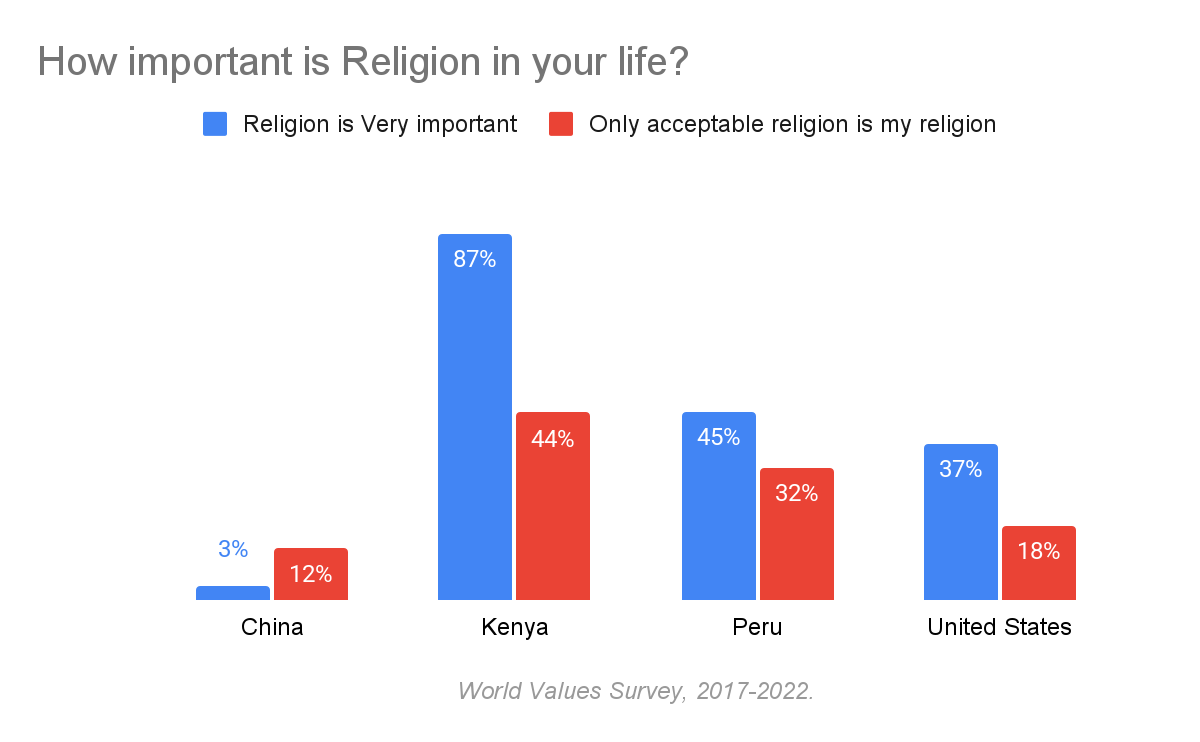
A large percentage of Kenyans say “Religion is very important to me” and “The only acceptable religion is my religion.”
However, a large number are also okay with cheating on their taxes and accepting a bribe at work.
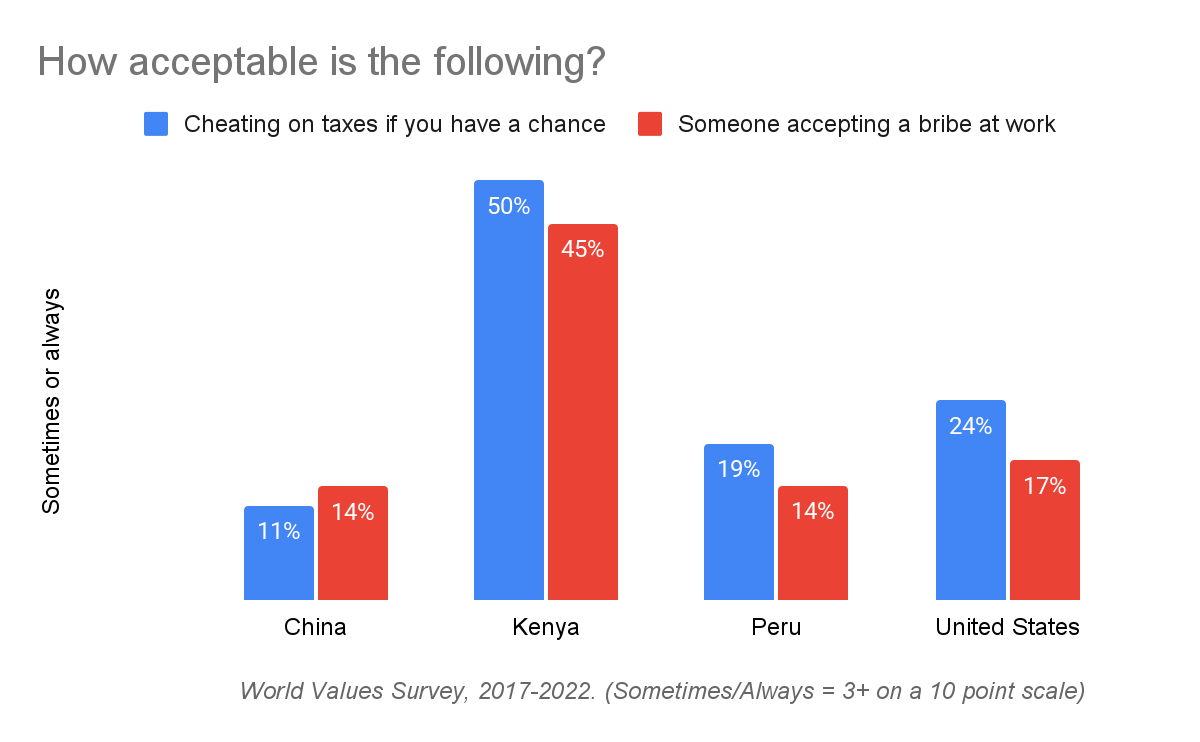
This is specifically prohibited in the bible: “Render to Caesar what is Caesar’s, and to God what is God’s” and “Do to others as you would have them do to you.” Therefore, is anyone stealing from their company/government really practising as a christian should?
What’s going on here?
I once stayed with a host family in Nairobi that graciously welcomed me into their home. The older brother, a junior pastor, wanted to marry a wonderful woman in his congregation from another tribe.
The mother upbraided her son that, due to her tribe, the fiancé was going to “steal his money and make him look bad in front of his guests. And make him clean the dishes!”
I appreciated the opportunity to hear directly from an educated, savvy business-woman in her 60s who I respected being so explicitly tribalist. I’m not sure I would have believed it could happen otherwise.
Moral universalism hadn’t quite landed for my host-mother yet.
We all know tribalism to be real. But how can we quantify it? Is Kenya really different from other countries?
Here’s what the World Values Survey says…
In Kenya, we have a high-trust of family (like all cultures), but low-trust of strangers. Just compare China and Kenya in Yellow:
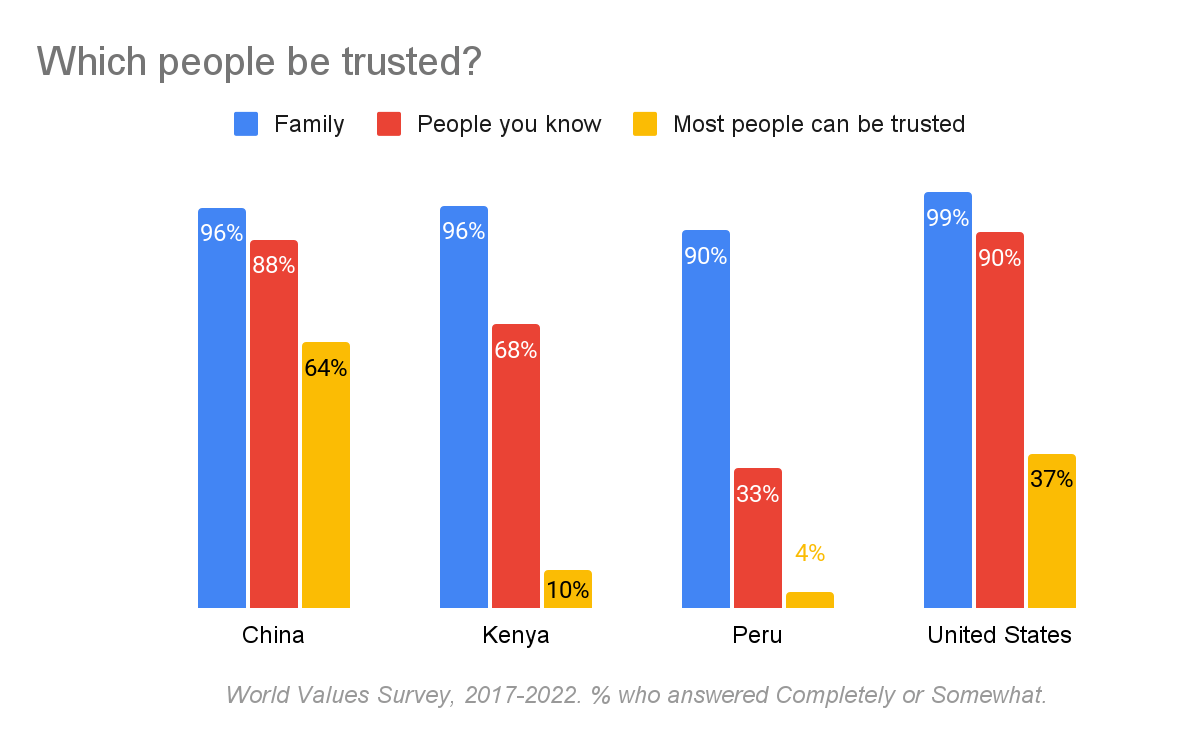
Kenyans trust family and friends, but don’t trust people from another tribe.
But that could be changing as we speak!
Millennials like my host brother—and especially GenZ in Nairobi—have little regard for tribal affiliation. We had our first non-tribal protests in Kenya in 2024. It will take another 20 years for non-tribalists to be firmly in power. We may have our first non-tribal vote in Kenya in 2028.
Tribal vote is strong but weakening. Some countries give 99%+ of the vote to one presidential candidate. But here are the number of counties in Kenya where one candidate received 85%+ of the votes:
2012: 21
2017: 21
2022: 8
As people move to cities they stop behaving in a tribalist way, stealing someone else’s bearskin just because they’re from a different tribe.
What caused this change? Why was it so sudden? It feels like a tipping point.
Enjoyed this? Sign up to see part 3 next week.
Christian atheists still assume christian virtues, such as killing people from a different tribe and taking their stuff is wrong. Thus most atheists in the west are actually Christian atheists. Some atheists try to claim religion is unnecessary, but then how do you decide right from wrong? According to Hume’s Guillotine, ethical values cannot be derived from facts or science. Jordan Peterson once said he was a christian atheist and then I realized I was too.