

Use "corruption" to your advantage
Is Corruption a Signal for Opportunity?

There was a crowd of people and police on a hill in Kangema, Murang’a. Men and women were running sprints.
It looked like a school sports day, except for all the police.
I asked the guy next to me what was going on.
“It’s tryouts for the eleven spots in the Murang’a police,” he explained.
“Oh, so the fastest ones get in?” I asked. It seemed like an odd way to select police officers.
“No,” he said. “The eleven were already decided. You give a bribe of Ksh 180,000 and you’ll be admitted.”
“And you?”
“I ran, but my dad could only offer a bribe of Ksh 100,000, so I won’t get a place.”
“Why did you run?”
“Well,” he said, “you never know.”

The issue is not that some police are corrupt. It is that, in many cases, people pay a bribe to become police officers. Then the job becomes a question of return on investment.
The structure is more complicated than simple petty corruption. A police officer has a boss. The boss expects a certain amount of money each day. The officer collects from motorists or businesses, keeps whatever remains after meeting the target, and passes the rest up the chain. If you do not hit your targets, you get pushed to a less lucrative post. If you do well, you can move to more lucrative posts with more “stopper-bys.” The boss keeps a portion, passes some to their boss, and so on up the ladder all the way to the top.
Everyone benefits from the lower levels.
But even that is not the full picture.
There are anti-corruption police. They investigate normal police officers and stop by their posts to see whether they are collecting bribes. If they find them with too many Ksh 50 and Ksh 100 bills, they know what is happening. Then the anti-corruption police can extort the regular police.
So the police hide some of their money in the bush. They risk being robbed by thieves and then not being able to pay their higher-ups, which could cost them their job.
The good news is that there is law enforcement. Motorists need insurance on their cars, otherwise the bribe can be substantial. The bad news is that many police officers earn around $200 a month, so taking bribes becomes a way for their families to survive.
That does not explain corruption at the higher levels.
Kenyan politicians are paid. In many cases, they earn many orders of magnitude more than an equivalent American politician would make relative to local incomes.
Then, on top of that, politicians make rules that help their individual businesses.
On a Friday, politicians make a rule that all motorcycle drivers must have reflective vests. For public safety, of course. And who can argue with safety?
Then, mysteriously, on Monday, reflective vests are available for sale everywhere. How could they have been imported so quickly unless the person making the law had planned for the reflectors to become available exactly when the law came into effect? Being a politician is perhaps the best business in Kenya: cronyism. And therefore, may attract the most talented and ambitious people.
My Own Run-Ins With Corruption
I once needed a new work permit.
I was referred to the chief immigration officer. We had a meeting. It was very cordial. I learned about his family, his farm, and his cows upcountry.
As I was leaving, he said, “I’m going to a funeral. I’d like some money to go to the funeral.”
I said, “Well, let’s see if we can get this work permit done first.”
He said, “Fine.”
Later, he came back and said, “Look, your work permit is ready. All I need is Ksh 20,000.”
So I said, “Let me come in and talk.”
I told him, “You want Ksh 20,000. I know you have cows at home. Why don’t I give you a Ksh 20,000 discount on installing a biogas system for you and your cows?”
He shrugged and said, “Okay.”
Ultimately, he never bought the biogas system. But it would have been pretty cool if I had made money from an immigration officer asking for a bribe.
Later, I applied for a second work permit. By then, I had published the story. They refused to give me a work permit on the grounds that I had claimed the chief immigration officer had requested a bribe.
Driving
Another time, I was driving with my girlfriend.
A police officer pulled us over and said, “You crossed a double yellow line. We need to go to the police station and report this.”
I said, “Okay. Let’s go to the police station.”
Two police officers got into the back of the car with AK-47s.
They said, “Look, it’s going to be very difficult for you at the police station. Just give us Ksh 5,000.”
I said, “I’ve been recording this conversation. I am going to take you to Integrity Centre and report you for corruption.”
My girlfriend winched. “What are you doing, Kyle?”
And I thought: what am I doing? I have two police officers with guns in the backseat. They could blow my head off anytime they want.
They said, “Let me hear the recording.”
That is where it got worse. I had been bluffing.
So I said, “I’ll show the recording at Integrity Centre.”
We drove off. They tried to argue that I should drive toward the police station. I kept driving toward Integrity Centre.
Then we got stuck in traffic for about an hour.
We started talking. I told them about the work we were doing with biogas. They got excited because they also had cows on their farms in Nakuru.
I asked, “So why are you asking for a bribe?”
They said, “We weren’t asking for a bribe. We just wanted to enjoy our Sunday with our families.”
I think they honestly believed that.
At some point, they said, “Just let us out of the car.”
I had kidnapped and blackmailed the police.
I had committed the crime of crossing a double yellow line. They could have let me off with a warning, but instead they decided to put a gun to my head. Not entirely figuratively.
I called their bluff. They tried to call mine. I did not reveal my cards.
Now they had wasted an hour. They could have been collecting bribes for the higher-ups. We continued on with our day.
The Restaurant
I ran a Thai restaurant.
Every day, the city council would come to inspect. They would always find something wrong.
The wrong amount of toilet paper. The wrong urinal configuration. Expired food.
They would claim they could report us, unless we gave them a bribe. The bribe was usually a funny amount. It was not $200. It was not even $20. They usually wanted $2 to $5.
And you think: fine. Big deal. Here’s some money. Go on your way.
But when this happens every day for a month, it becomes annoying.
Eventually, I said to them, “Look, you’ve asked for a bribe. I recorded you. I’m going to report you for corruption.”
At that point they got upset.
“We’re going to bring the boys,” they said. “We’re going to shut this place down.”
I said, “Okay. Call the boys.”
I thought I was being brave. Then I realized I might have made a huge mistake by challenging them. Was $5 a day really so bad?
They said, “The boys are busy. We’re going to come tomorrow and shut your place down.”
I got ready for them to come the next day.
The boys never showed up.
They never bothered us again.
After that, you realize bullies only pick on the weak.
What If Corruption Is Not the Opposite of Development?
The usual idea is that if we reduce corruption, we can increase economic development in Kenya.
If only corruption were lower, development would be higher.
But that flies in the face of the evidence.
The evidence suggests that other countries are not necessarily less corrupt. They have more formalized, legalized corruption.
In China’s Gilded Age, Yuen Yuen Ang starts with an interesting story.
A man named Mr. Fu had a successful railroad, built partly by bribing politicians with suitcases full of money to secure land. He made so much money from the railroad that he started a great university: Fu University.
But then the author reveals the twist. It was not Mr. Fu. It was Mr. Stanford. He started Stanford University with money made from the railroad business in 1800s America.
Was that good or bad?
Ultimately, Stanford University has led to extraordinary education and innovation. The railroad allowed people to travel where they could not travel before.
So we find that countries that developed were often quite corrupt.
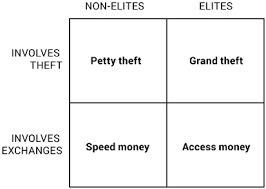
Ang goes on to describe four kinds of corruption.
Grand theft: the president stealing mineral wealth from a place like the Democratic Republic of Congo.
Petty Theft shakedowns: the police stop your car and say your taillight is out. You say, “No, it’s not.” They hit your taillight with their gun and say, “Your taillight is out.”
Speed Money. You want your passport faster. In the United States, you can pay for express service. In Kenya, if you know a guy and give him $50, you get your passport quicker so you can get to Dubai and do that important business deal. Ultimately, it may be good for you to do the deal, and it may be good for the economy. You are willing to pay more to get your passport stamped. In the US, there is a legal route. In Kenya, the route is informal and illegal.
Access Money. This is knowing the right people, shaking the right hands, making the right political donations, and having the right connections. It helps you build the bridge you need. It helps you get your drug approved more quickly than it otherwise would have been. It gets you into the room.
The American economy was more dynamic before 1950, when this sort of corruption was more possible. Now you cannot bribe politicians with suitcases of cash. You have to use lobbying, consultants, donations, regulatory workarounds..
Slower. More expensive. More respectable. Less progress.
Pros and cons.
People who want to grow an economy without a realistic discussion of corruption are like a white-gloved princess who wants to eat steak and potatoes without getting her hands dirty or killing a cow.
Legalized Corruption
The amount of corruption in the United States still surprises me.
A friend was trying to build a house in Hawaii. He was told he needed a permit. Depending on how big the project was and how fast he needed approval, there was a consultant who could help him get the permit.
The permit itself cost $500.
The consultant’s fee was between $30,000 and $60,000.
The permit office had realized it controlled who got permission. And, would you believe it, the consultant was an old buddy of theirs.
It does not seem like the United States eliminated corruption. It does not seem like reduced corruption is what caused development. It looks more like developed countries learned to legalize, formalize, and professionalize corruption.
As Clayton Christensen argues in The Prosperity Paradox, corruption is not the problem. It’s the solution. Or at least the first clue of a solution. Often, corruption is a symptom of a broken system. It shows that someone cares enough to get something done, but the official path is too inefficient.
Think about music piracy.
For years, people pirated music online. Then streaming became easier. Almost all music piracy disappeared. It was not that people were unwilling to pay. It was that buying CDs and albums did not fit the modern world, and the corporations had not caught up.
Once the system adapted, the piracy went down.
In India, a patient once had to pay $5,000, use special influence and often make unofficial payments (bribes) to move up the queue for heart surgery. Then came Narayana, which applies an industrial, high-supply model to medicine. They perform heart surgery for $1,000 per person and treat as many people as possible. By increasing supply so dramatically, they eliminate the scarcity that demands a bribe for access. Narayana makes more money by serving way more customers, attracting medical tourism—good for the whole Indian economy, and increasing the utilization rate of expensive equipment.
Corruption is not always the disease. Sometimes it is the signal that something scarce, slow, or broken is valuable enough for people to pay extra to access it.
Power Attracts the Corruptible
Catherine Austin Fitts served under President George H. W. Bush as Assistant Secretary of Housing and Federal Housing Commissioner at HUD. During her time there, she became critical of how public housing money was being spent.
She argued that thousands of housing units scheduled for demolition could instead be saved with relatively inexpensive refurbishments costing around $5,000 per unit, rather than replaced with new construction costing hundreds of thousands of dollars. According to Fitts, when she pushed for the cheaper option, she was told that large redevelopment projects were necessary to help political supporters “eat,” meaning politically connected contractors and interests benefited from higher spending.
Fitts said she refused to go along with what she viewed as massive waste and corruption involving taxpayer money. After leaving HUD, she claimed she was blackballed and became the target of years of investigations and legal pressure connected to her company, Hamilton Securities, which had worked with HUD.
She also said her family received threats and that she spent $2 million defending herself against the Justice Department and other federal investigations.
The investigations lasted for years, but ultimately no criminal charges were brought against her. Investigators later stated they found no evidence of wrongdoing by Fitts or her company.
Big Tech operates in a more elegant version of the same game.
Big Tech lobbies for better consumer protections. Consumer protections mean every market has different requirements for how websites access and manage data. Big Tech and large companies can afford to handle these requirements. A new startup cannot.
The result is that Big Tech climb up the ladder and then pull the ladder up behind them.
It is not illegal.
They give donations to people who make the rules. They get themselves into the room. Then they get rules made in their favor. Access money.
It sounds a lot like corruption.
Marc Andreessen, the founder of Netscape, has started lobbying government through his investment firm a16z on behalf of what he calls “Little Tech,” the opposite of Big Tech.
Can Africa Leapfrog Corruption?
It is not obvious that corruption changed that much in the United States. So what is the difference, and why do Americans speak with so much authority about how Africa should develop?
Maybe there is a way to leapfrog corruption the same way Africa leapfrogged landlines with mobile phones.
Before the British showed up, there was a system that worked. If you were on the chief’s land, you gave money to the chief for safe passage.
Then democracy arrived, and suddenly that same human behavior was called corruption.
But the old system worked. And as far as we can tell, that is how human nature works everywhere.
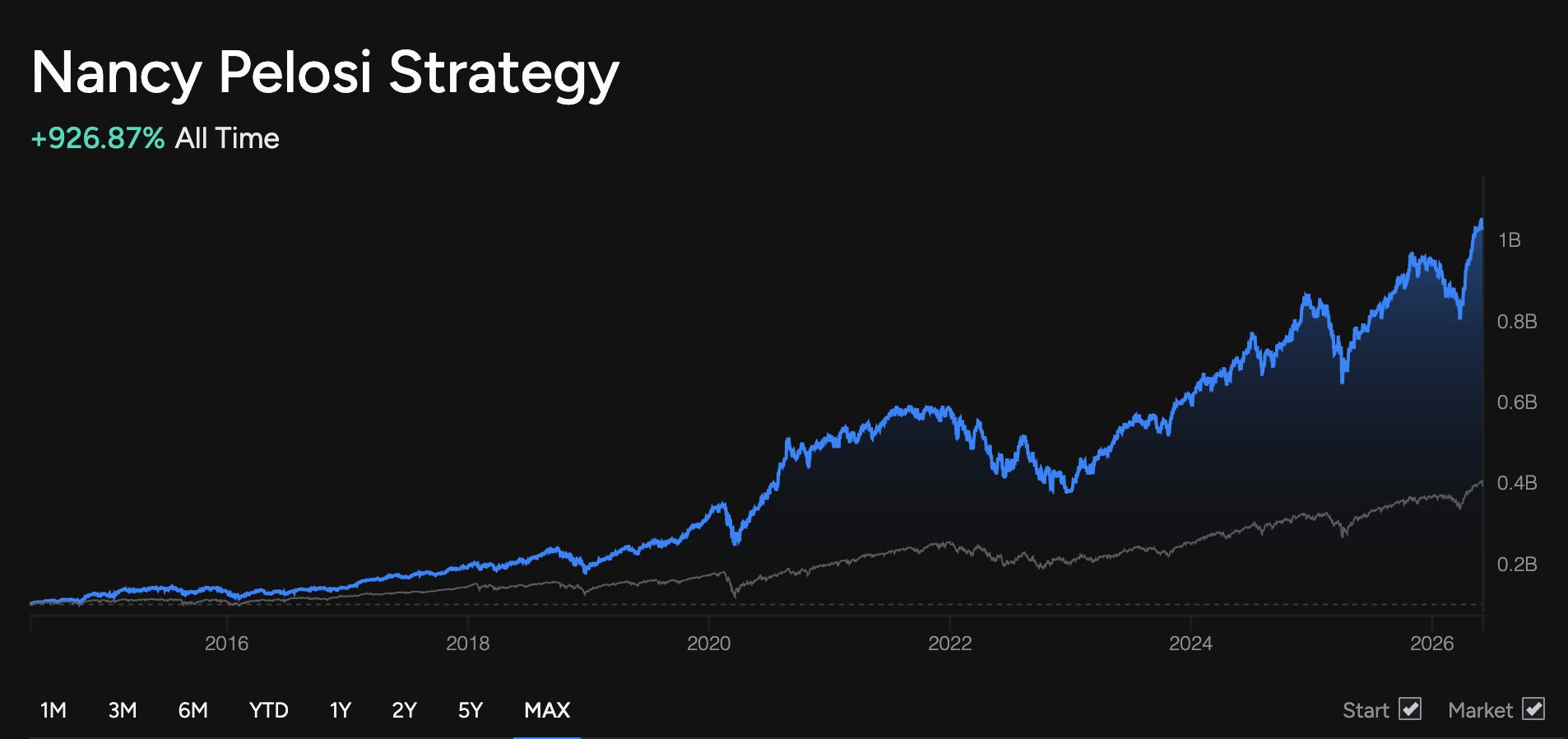
Places like the United States and China have found ways to legalize corruption. Politicians can own stocks and trade ahead of major decisions. US politicians have reportedly beaten the market by extraordinary margins, which would suggest they are better stock pickers than Warren Buffett. Or maybe have insider information.
A Bribe I Wish I Could Have Paid
When my biogas business was failing, I thought: what if we could just do normal fossil fuels?
I went to visit my business school classmate in Juba, South Sudan. The country had recently become independent and was known for being oil-rich.
My friend had survived nearly a decade as a child soldier before being reunited with his family when he was seventeen. He escaped to Kenya, got an education, and now had a contract to print all the number plates on cars in South Sudan.
He was considering getting into oil and gas.
In Juba, we drove up to one of the few stoplights in the entire city. I was surprised that people actually stopped.
Across the way were a bunch of mud huts in the middle of the city. I found this intriguing, so I took a picture with my phone.
“No! Don’t!” my friend shouted.
But it was too late.
We were surrounded by dozens of men with machetes and guns. It would have been impossible to drive through them without killing someone.
My friend said, “Okay. This is bad. Wait for me here.”
He got out of the car and locked the door.
“Don’t go anywhere.”
Half the men went with him. The other half stayed outside the car, looking menacingly at me.
I thought: What the hell just happened?
He came back and said, “That is the compound of the president’s wife’s family. They say there was an American spy here, and you are probably the one.”
I looked down at my iPhone 4 and thought: if only.
“They want to execute you,” he said, “but I’m trying to negotiate on your behalf.”
“I think that’s great,” I said. “Keep negotiating. Can’t we just give them a little something and they’ll go away?”
“No,” he said. “This is about honor. Money doesn’t mean anything to them.”
The country had been in civil war for too long. Hyperinflation meant money was not worth much.
We left the car surrounded by men with machetes and AK-47s and went into a big tent. They sat around the edges. They gave me the only chair. Meanwhile, they squatted on the ground.
The thing about squatting on the ground in robes, while not wearing underwear, is that the family jewels hang out the bottom.
They discussed my fate for twenty minutes, loudly and intensely, while I understood not a single word.
Oh my God, I thought. This is how I die: executed by guys with their balls hanging out.
Ultimately, they decided I was not an American spy, and we got out of there.
No more pictures.
I wished we could have just paid a bribe.
The Goldilocks Problem
Maybe corruption is not so black and white.
Maybe there is a more nuanced way to solve it, rather than trying to root out something as old as human history.
The real question is not: how do we eliminate corruption?
The better question is: how do we make the underlying function of corruption productive?
How do we turn shakedowns into express lanes?
How do we turn bribes into service fees?
How do we turn access money into competitive markets?
How do we turn informal relationships into scalable trust networks?
The countries that developed economically like China seem to have found a Goldilocks phenomenon: not too much corruption, because then the economy collapses into predation; but not too little either, because then the system becomes rigid, bureaucratic, and slow.
The goal is not purity.
The goal is function.
Elon Musk explained why he left the Department of Government Efficiency, to paraphrase: The government waste problem is ~$10T. The amount of savings possible might be $100b, due to political challenges. Instead of improving efficiency by 1%, why not make the pie 1,000% bigger with AI, robots and automations?
What’s the clever way to accelerate progress in Kenya, rather than trying to reduce corruption directly?
Solutions
On-call legal support.
In the US, @Attorney.Shield is a subscription where if you are stopped by the police, they will have a lawyer available to talk to the police on video call so you always know your rights and always have legal representation. Combined with a dashcam should deter shakedowns. A business opportunity.
A single stick is easy to break; a bundle of sticks is not
Individually small companies don’t stand a chance against governments, cheap imports and big corporations. But together they can be strong.
This is what Kuzana builds. Among tens and eventually thousands of entrepreneurs we will be strong. Like the “Little Tech” Marc Andreesen represents in the US, a large enough group of small companies will be stronger than any big company or government.
Pay Police more
Halve the number of police and double the salaries of the top police. Of course not easy to do politically.
The great future
Being a Live Player does not mean importing Western lectures about governance from countries that legalized their own corruption and then forgot what they did.
It should mean looking honestly at human nature, incentives, scarcity, access, speed, and trust.
Where there is corruption, there is demand.
Where there is demand, there is a business opportunity.
And where there is a business opportunity, there is a chance to build something better.
In Kenya, this means:
More Energy. This will be Geothermal for the foreseeable future (renewables are intermittent and nuclear is at least a decade away).
More factories. The cost of energy in Kenya is too high for manufacturing to be globally competitive, but as geothermal energy increases so will manufacturing, especially close to energy sources in the rift valley.
More “schools”. AI tutors will be ubiquitous and the most ambitious people will be self taught.
Better Medicine. An AI assistant for every doctor will mean the best of both worlds where your diagnosis will take into account not one doctor’s knowledge, but the entire knowledge of the world.
More Housing. Most of the cost of housing is due to land cost, driven by demand in Nairobi. As jobs decentralize from Nairobi, the cost of a nice home in Kenya will reduce as other cities grow.
The Live Player answer is not to wait for clean institutions and then build.
Harness the hunger, ambition, greed, fear, loyalty, and status games that already exist, and aim them at production instead of predation.